-Ray Vensel
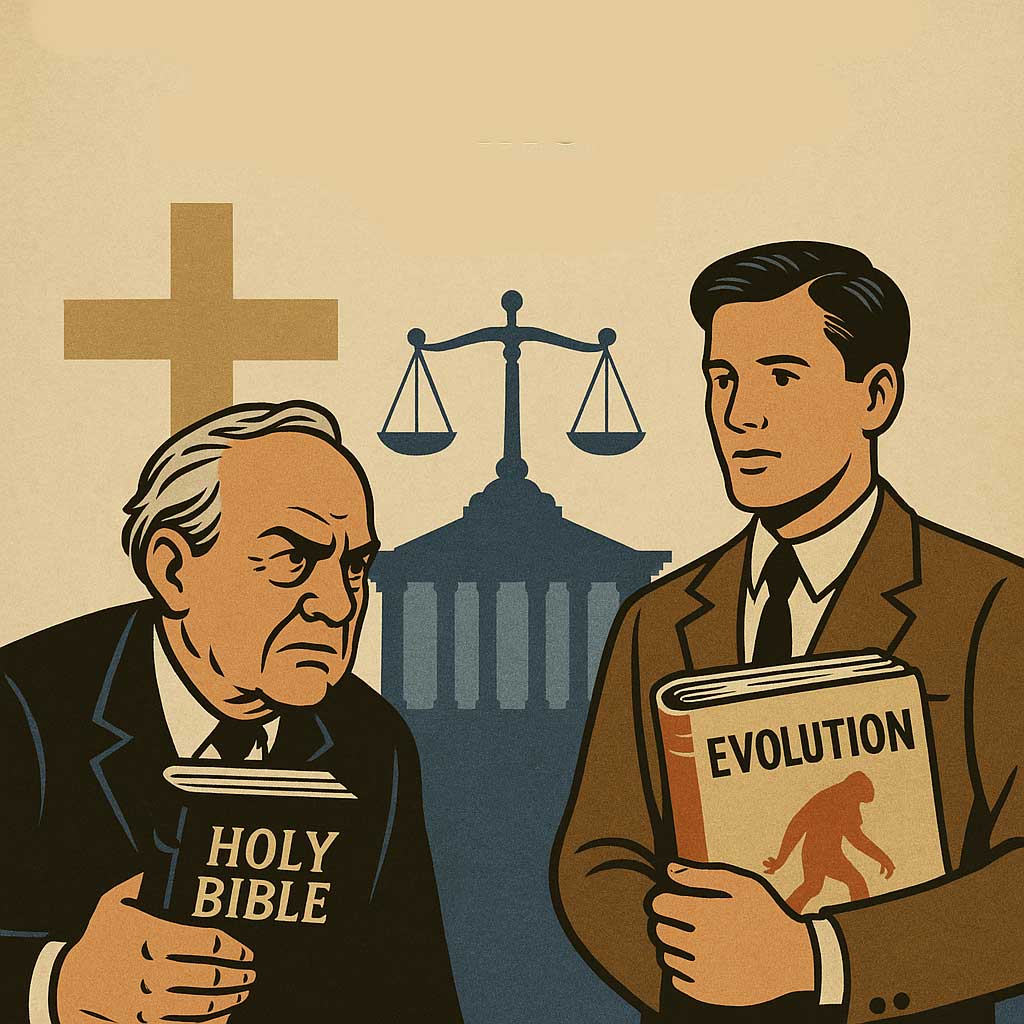
After William Jennings Bryan lost the Presidential election of 1896, he began a career of paid lectures peddling elixirs for whatever ailed you. Eventually he attacked science in general and supported the positions taken by Warren Harding’s Return to Normalcy: “Put America First” by increasing tariffs, limiting immigration, and maintaining order by force. This expanded to requiring bible reading, mandating the teaching of capitalism, and prohibiting teaching that “ours is an inferior form of government”. Bryan’s ultimate conclusion was that “all the ills from which America suffers” could be traced to the teaching of evolution. Soon afterwards Tennessee passed the Butler Act to forbid this teaching.
The ACLU offered to defend any teacher prosecuted under the law. John Scopes volunteered to say that he used a textbook that included evolution while substituting for a biology class. He was indicted. There is no documented proof that he actually taught the class.
There was a confluence of interests. The ACLU’s concern was academic freedom. Defense attorney Clarence Darrow was an atheist, the local prosecutor was trying to get his University of Tennessee job back, Bryan was pro-bible anti-evolution, and the city of Dayton sought the economic benefits of national publicity.
The trial lasted from July 10 to July 21, 1925. Scopes was found guilty, but the verdict is referred to as “overturned on a technicality”. The judge had issued a $100 fine, which was $50 more than he was legally allowed to issue. He should have had a jury determine the amount above $50. Everyone claimed victory. But what did it all mean?
The trial represents the difficulties when religion influences the teaching of scientific change. It is also a reminder of the importance of maintaining the Constitution’s boundary between religious beliefs and public policy, including public education. In a time dominated by social media, misinformation, and political polarization, defending science-based learning is more important than ever.
The trial was just one stage of a struggle, and with time its significance has only deepened. While teaching evolution is now protected by law in public schools, including Maine, efforts to introduce alternatives such as “intelligent design” show that tension between science and belief persists.
Contemporaneous local press coverage is interesting. Several Maine papers had front page coverage and multiple angles on the case, and the Portland Press Herald of July 13, 1925 had this headline on one article: “Dr. Lehman, director of Maine Summer Camp, offers position to sister of John T. Scopes.”
Dr. Lehman, director of the Highland Nature Camp in North Sebago, had offered a position to Lela Scopes to teach science and mathematics at an exclusive school for girls in Tarrytown, New York. He did this because she had been dropped from consideration as a mathematics teacher at a school in Kentucky because of her refusal to recant her belief in evolution. According to the paper, “Dr. Lehman expressed the opinion that the Scopes trial was entirely out of keeping with present day enlightenment and that the Tennessee Anti-Evolution Law, or any other effort to prescribe truth by legislation, would ultimately fail.”
The Morning Sentinel had a report of the estimated total costs (about $25,000): attorneys fees were zero and they paid their own expenses, court costs $300 (triple the amount of the fine), expert witnesses (who were not allowed to testify): $20,000 to $25,000. So, this crucial trial had neither a winner nor a loser and cost a lot of money.
But it’s worth recognizing its importance on its 100th anniversary. The same misguided thinking that excreted the Butler Act is still active.
Ironic footnote: at the bottom of that Sentinel page is an ad for “LF Atwood’s Medicine”, promoted as a cure for just about all conditions, some of which might offend readers’ sensibilities. I wonder if Bryan kept a bottle with his other elixirs.